

What Experience Do You Need Before Yoga Teacher Training? - with Lotus River Wellness
The most common fear before yoga teacher training is simple: “Am I experienced enough?” The honest answer is usually more encouraging than expected. Most people do not need to master advanced poses, know Sanskrit, or have years of daily practice before entering training. They do need a steady relationship with yoga, a willingness to study, and enough self-awareness to learn safely.
A strong yoga teacher training program should not expect every student to arrive as a finished teacher. It should help sincere students become prepared, grounded, and confident step by step.

You need a consistent personal practice, not a perfect practice
Before yoga teacher training, the most useful experience is a consistent personal practice. That does not mean practicing for two hours every day. It means yoga has become familiar enough that the body, breath, and attention can stay present through a full class.
A practical baseline might look like this:
Attending classes regularly for several months
Practicing at home between classes
Knowing how common poses feel in your own body
Understanding when to rest, modify, or ask for support
Having curiosity about more than the physical shapes
This matters because teacher training asks students to observe yoga from two angles at once. There is the experience of practicing, and there is the study of how practice is taught. If someone is still unsure what a sun salutation feels like, why props help, or how breath affects movement, the training may feel overwhelming.
That said, “consistent” does not mean “advanced.” A student who practices three times a week with attention may be more ready than someone who performs difficult postures but has little body awareness.
Many respected yoga education standards use a 200-hour format as a foundational level for teacher preparation. These programs commonly include posture technique, teaching practice, anatomy, yoga philosophy, ethics, sequencing, and observation. That mix shows why personal practice matters. Training is not only about learning poses. It is about studying the whole method.
You do not need to be flexible, thin, young, or highly athletic
One of the least helpful myths about yoga teacher training is that students must already look a certain way in poses. Yoga does not require a particular body type. Good teaching requires attention, clarity, care, and the ability to guide real people with real bodies.
Flexibility also has limits as a measure of readiness. A person can be naturally mobile and still lack strength, stability, or safe alignment habits. Another person can be stiff and become a thoughtful teacher because they understand adaptation well.
A future teacher benefits from knowing what it feels like to work with limits. For example:
Tight hamstrings can teach patience in forward folds.
Sensitive wrists can teach creative options for plank and downward-facing dog.
Balance challenges can teach humility and better cueing.
A busy mind can teach compassion during meditation and breathwork.
The U.S. National Center for Complementary and Integrative Health notes that yoga is generally considered safe for many people when practiced appropriately, but injuries can occur, especially when people push beyond their capacity or practice without proper guidance. That supports a key point: readiness is not proven by intensity. Readiness grows from learning how to practice with awareness.
A good training environment should treat modifications as part of skilled practice, not as a lesser version of yoga. That approach helps future teachers serve a wider range of students.

You should have enough class experience to know what teaching feels like from the student side
Yoga teacher training is easier to absorb when there is a memory bank of classes to draw from. Students who have taken different kinds of classes often recognize patterns more quickly. They notice how teachers open class, cue breath, offer options, build sequences, create rest, and close practice.
Useful pre-training experience includes noticing questions such as:
What kinds of cues make a pose clearer?
When does a class feel rushed?
How does a teacher make beginners feel welcome?
What helps the nervous system settle?
How do transitions affect safety and focus?
This does not require an academic background. It requires paying attention.
For instance, in a standing balance sequence, a teacher might first prepare the feet and hips, then introduce a simpler balance, then offer a more challenging shape. A student who has experienced that progression many times will better understand sequencing during training.
The same is true for rest. Many new trainees think teaching means filling every moment with words. Regular class experience shows the opposite. Silence, stillness, and a slower pace often help students integrate what they are learning.
You need curiosity about anatomy and safety
Yoga teachers do not need to become medical professionals. They do need a basic respect for anatomy, movement, and safety. Before training, it helps to be curious about how joints move, why alignment differs from person to person, and why one cue may not work for every body.
A prepared trainee does not need to know every muscle name. They should be ready to learn ideas such as:
The spine moves in several directions, including flexion, extension, rotation, and side bending.
Joints have different shapes and ranges of motion.
Sensation is different from pain.
Repetition, load, and fatigue affect safety.
Breath can change effort, rhythm, and attention.
This matters because yoga teaching often involves quick decisions. If a student says a pose hurts their knee, the teacher must know how to respond responsibly. That may mean offering a different foot position, reducing depth, using support, or suggesting the student skip the pose.
Training should also cover scope of practice. Yoga teachers can guide movement, breath, relaxation, and awareness. They should not diagnose conditions or promise medical outcomes. This distinction protects both teacher and student.
Research on yoga often suggests possible benefits for stress, mood, sleep, flexibility, and quality of life, but effects vary by person and study design. Any health-related discussion in yoga education should stay careful, accurate, and grounded. This article is informational only and does not replace medical advice.
You should be open to yoga philosophy, not just yoga poses
Many people first come to yoga through movement. That is a valid doorway. Teacher training, though, usually expands the view.
Yoga includes practices and teachings related to breath, meditation, concentration, ethical living, self-study, and awareness. Classical yoga texts describe yoga as a discipline of the mind, not only the body. Modern training programs often include philosophy because teachers need context for what they are sharing.
Before entering training, students do not need to have studied philosophy deeply. They should be willing to ask larger questions:
What is yoga beyond exercise?
How do breath and attention affect practice?
What does it mean to teach ethically?
How can a teacher create a respectful space?
How does personal practice shape teaching voice?
This openness matters. A teacher who only knows shapes may offer a workout. A teacher who studies the broader practice can offer a class with clarity, care, and purpose.
You need emotional readiness to be a student again
Teacher training can be joyful, but it can also feel vulnerable. Students practice teaching out loud. They receive feedback. They examine habits. They may discover that a familiar pose has more layers than they realized.
That is why emotional readiness matters.
A ready trainee can say:
“I do not know yet.”
“Can I try that again?”
“That feedback helps.”
“This pose does not work for my body today.”
“I need support with this concept.”
These skills are not secondary. They are part of learning to teach.
Teaching yoga requires presence under pressure. A new teacher may forget a sequence, mix up left and right, or lose their words in front of a group. Training gives space to practice those moments before teaching publicly. Students who can stay curious instead of self-critical tend to grow faster.
Feedback is especially important. In many adult learning settings, practice plus clear feedback helps students build skill more effectively than information alone. Yoga teacher training follows that same principle. Reading about cueing is useful. Cueing a pose, hearing how it lands, and trying again builds real ability.
You should have time and space to commit to the training
Experience is not only measured in years of practice. Readiness also includes your schedule, energy, and support system.
A teacher training program asks for attention outside live sessions. Students may need time for reading, practice, written reflections, video review, observation, peer connection, and teaching assignments. If life is already stretched to its limit, even a well-designed program can feel hard to absorb.
Before enrolling, it helps to look honestly at:
Weekly time available for study and practice
A quiet space for virtual sessions
Reliable internet for online learning
Physical space to roll out a mat
Support from family or housemates during training times
Capacity for rest, not just productivity
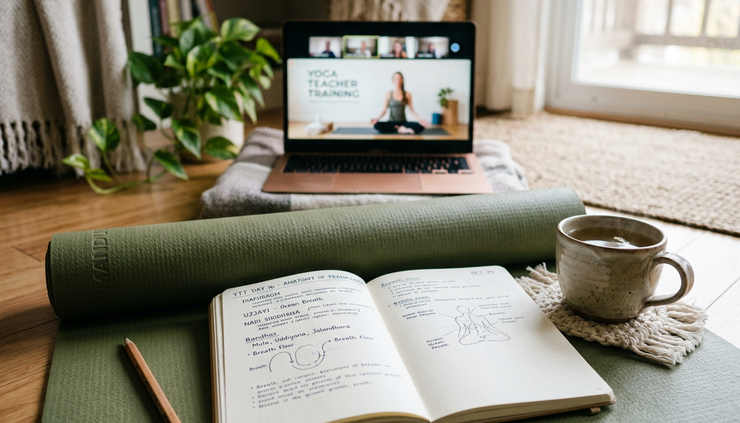
Virtual training can make yoga education more accessible nationwide because students do not need to relocate or commute. Still, online learning works best when students treat it as real education, not background noise. A quiet home setup and a clear routine can make a major difference.
How Lotus River Wellness helps students feel prepared
The right training program does not simply ask, “Are you ready?” It helps students understand what readiness means and supports them in building it.
Lotus River Wellness can help future trainees prepare by focusing on the foundations that matter most: steady practice, safe movement, clear teaching skills, self-study, and confidence. That kind of preparation is especially helpful for students who feel called to teach but worry they are not advanced enough.
A strong preparation process may include:
Clear expectations before training begins
Students benefit from knowing what the training will involve, how much time to set aside, what materials are needed, and what skills will be practiced. Clear expectations reduce anxiety and help students plan.
Support for different bodies and experience levels
A training that offers modifications, props, and options teaches future instructors how to serve more than one “ideal” body. This is practical teaching education.
Step-by-step teaching practice
New teachers need repetition. They need to practice cueing, sequencing, observing, and adjusting their language. Short practice teaching sessions can build confidence before longer teaching assignments.
A balance of practice and study
Effective teacher training includes both lived experience and structured learning. Students practice yoga, then study why a sequence worked, how a pose was prepared, or what made instructions clear.
Room for questions
Preparation improves when students can ask direct questions without feeling behind. A supportive learning space helps students move from uncertainty to skill.
If someone is searching for Yog Teacher Training, the best next step is not to find the most intense program. It is to find a program that teaches the foundations well and supports the whole student.
Signs you are ready to apply
Readiness is rarely a dramatic moment. More often, it looks like a steady inner pull and a practical ability to show up.
You may be ready for yoga teacher training if most of these feel true:
You practice yoga regularly enough to know how it affects you.
You are interested in learning, not just performing.
You can receive feedback with openness.
You want to understand breath, alignment, philosophy, and teaching.
You respect safety and scope of practice.
You are willing to modify poses when needed.
You can make time for training, study, and practice.
You feel drawn to share yoga, even if your voice shakes at first.
You do not need to feel completely confident. Confidence is built through training. You need sincerity, consistency, and the willingness to keep learning.

A simple pre-training plan for the next four weeks
A short preparation period can make training feel smoother. This plan is not required, but it gives structure to students who want to feel more grounded before starting.
Week | Focus | Practice idea |
1 | Build consistency | Practice three times, even if sessions are short. Notice breath and energy before and after. |
2 | Study your body | Use props or modifications in familiar poses. Write down what changes. |
3 | Observe teaching | Take class and notice cueing, pacing, transitions, and rest. |
4 | Practice reflection | Journal after practice. Try explaining one pose out loud in simple language. |
The goal is not to become an expert in a month. The goal is to arrive more awake to the learning process.
The real experience you need
The best preparation for yoga teacher training is not a perfect handstand, a flawless split, or a long list of advanced classes. The real experience needed is a steady practice, honest self-awareness, interest in the full scope of yoga, and readiness to learn in community.
The strongest teachers often start as sincere students who pay attention. They know what it feels like to be unsure. They know how helpful a clear cue can be. They know the value of rest, patience, and practice.
For those ready to explore the next step, learn more about teacher training with Lotus River Wellness. A thoughtful program can help turn interest into preparation, and preparation into the confidence to teach with care.


Comments