

How to Land Your First Yoga Teaching Job
Getting certified is a meaningful accomplishment. It takes discipline, practice, study, and the courage to let yourself be seen as a teacher.
It is also only the beginning.
A yoga teacher training certificate gives you a foundation. It does not automatically hand you a class on the schedule, a full room, or the confidence to walk into every teaching situation with ease. That part comes through practice, relationships, feedback, and the willingness to begin before you feel perfectly ready.
Lotus River Wellness, founded by Steph Cole, E-RYT 500, is a Yoga Alliance Registered Yoga School built around that truth. LRW training emphasizes practice teaching, mentorship, feedback, professional confidence, and finding your own teaching voice so graduates are prepared to pursue real opportunities, not simply hold a certificate.
The first teaching opportunity often comes from movement, not waiting.

Start teaching as soon as you can
The fastest way to become a yoga teacher is to teach yoga.
That does not mean teaching beyond your scope. It does not mean pretending to know what you do not know. It means finding safe, low-pressure ways to practice your skills with real people.
Start with simple options:
Teach a short class for friends or family.
Offer a beginner-friendly community practice.
Lead a gentle class at a local gathering space.
Volunteer with an organization that already serves people you care about.
Record yourself teaching a short sequence and review it.
Practice cueing out loud, even when you are alone.
Confidence is built through repetition. A strong teacher training gives you tools, but teaching teaches you timing, presence, pacing, nervous system awareness, and how real bodies respond in real rooms.
In LRW training, practice teaching matters because it closes the gap between knowing and doing. You learn how to give clear cues, hold space, adjust your plan, receive feedback, and keep going when a class does not unfold exactly as expected.
That is professional growth.
Create a simple yoga resume and teaching bio
You do not need a complicated website or a polished media kit to begin. You do need a clear way to introduce yourself.
A simple yoga resume or teaching bio helps studios, gyms, nonprofits, community groups, and private clients understand who you are and what you can offer.
Include the basics:
Your name and current yoga certification.
Training school and style of training.
Any continuing education or related experience.
Populations you feel prepared to serve.
Class styles you can teach within your scope.
Relevant life or professional experience.
A short teaching statement.
Keep it honest. If you are a new teacher, say that with confidence. New does not mean unprepared. It means you are building experience and staying teachable.
Write a bio that sounds human
Avoid trying to sound like every other yoga teacher. A good bio should answer three simple questions:
What do you teach?
Who do you enjoy serving?
What can students expect in your class?
For example:
“I teach accessible, breath-centered yoga for people who want to build strength, mobility, and steadiness without feeling pressured to perform. My classes focus on clear alignment, grounded pacing, and options for different bodies and experience levels.”
That is clear. It does not overpromise. It gives someone a reason to keep reading.
Professional does not have to mean complicated. It has to mean clear.
Ask the better question before you apply everywhere
Many new teachers ask, “Where can I get hired?”
Steph often guides teachers toward a stronger question:
“Who am I uniquely qualified to serve?”
That question changes everything.
Your first opportunity may be linked to your lived experience, your career background, your community, your personal healing path, your age group, your communication style, or a population you already understand.
A veteran may feel called to serve military and veteran communities. A classroom teacher may be well suited for schools or youth programming. A caregiver may understand the needs of people under stress. A former athlete may connect naturally with strength, mobility, and recovery work.
This does not mean your identity is your only teaching lane. It means your life can point you toward relationships and communities where trust already has a foundation.
Let your niche come from service
A niche is not just a marketing category. In yoga teaching, it should come from service.
Ask yourself:
Who do I understand with care and respect?
Where do I already have relationships?
What spaces have shaped my life?
What needs have I seen up close?
What kind of class would I have benefited from at an earlier point in my life?
What training and mentorship do I still need to serve this group responsibly?
The best teaching path is not always the most obvious one.

Do not limit your first job to a studio class
A studio class is one valid path. It is not the only path.
Many new teachers get stuck because they imagine a first yoga teaching job as one thing: a weekly class at a yoga studio. That can happen, but studios often have limited schedule space, established teachers, and specific class needs.
If you only look there, you may miss an opportunity that fits your skills better.
Consider settings such as:
Gyms and fitness centers.
Nonprofits and community organizations.
Military and veteran programs.
Public service or first responder wellness programs.
Schools and youth programs.
Retreats and special events.
Private clients or small groups.
Virtual classes.
Senior centers or accessible movement programs.
Recovery-oriented or stress-supportive community offerings.
Corporate wellness programs, when taught within a wellness scope.
This is where Steph’s experience matters. LRW’s work has grown beyond studio walls through military and veteran communities, nonprofit partnerships, community relationships, and specialized programming. These opportunities often start with listening first, then building something that meets a real need.
A yoga class in a community center can matter deeply. A short weekly practice for veterans can build trust over time. A private session for someone returning to movement can be significant. A nonprofit partnership can reach people who may never walk into a studio.
Your first teaching opportunity may not look glamorous. It may still be exactly where your teaching becomes real.
Build relationships before asking for a class
Yoga is relational work. The way you approach opportunities should reflect that.
If you want to teach in a space, spend time understanding the space first. Take a class if appropriate. Attend an event. Learn the mission of the organization. Notice who they serve and what kind of support they already offer.
Then reach out with respect.
A good message is short, specific, and useful. It should include:
Who you are.
What you are trained to teach.
Why you are reaching out to that specific place.
Who you feel prepared to serve.
A simple offer to talk or share a sample class.
Your resume or short bio.
Avoid sending a generic message to every place in town. People can feel that. A thoughtful note stands out because it shows you paid attention.
Approach studios and organizations professionally
Professionalism is not about sounding stiff. It is about making it easy for someone to say yes, no, or not right now.
Use a clear subject line. Keep your email brief. Attach or link your resume. Include your availability. If you are proposing a workshop or community class, explain the purpose in plain language.
For example:
“I recently completed my 200-hour yoga teacher training and am building experience teaching accessible, beginner-friendly classes. I have a background working with community groups and would love to explore whether a gentle stress-relief class could support the people you serve.”
That message is direct. It names the population and the offering. It does not demand a job.
Be specific about the help you can offer. That is stronger than asking if anyone is hiring.
Prepare for auditions and sample classes
If a studio, gym, or organization asks you to audition, treat it as a teaching opportunity, not a performance.
You do not need to show every pose you know. In fact, you should not. A strong audition usually shows that you can create a safe, coherent experience for the class level requested.
Prepare:
A simple sequence with a clear beginning, middle, and end.
Breath cues that support the movement.
Options for common needs.
Clear transitions.
A grounded closing.
A short introduction that names what students can expect.
Practice your timing. Teach out loud. If the audition is 20 minutes, do not prepare a 60-minute class and hope it fits. Respect the format.
Keep your scope clear
A new teacher should know what they are ready to teach and what they are not ready to teach yet.
Teach classes that match your training. Refer out when a student needs medical, therapeutic, or mental health support outside your role. Stay curious, keep studying, and seek mentorship when you enter specialized spaces.
This is one reason Yoga Teacher Training with Lotus River Wellness emphasizes feedback and teaching voice. A teacher needs more than a sequence. A teacher needs discernment.
Scope is not a limitation. It is part of ethical teaching.

Ask for feedback and follow up
Feedback is one of the most practical tools a new teacher has.
After you teach, ask for specific feedback from a mentor, training faculty member, studio owner, program director, or trusted peer. Do not only ask, “Was it good?” Ask useful questions.
Try these:
Where did the class feel clear?
Where did the pacing feel rushed or slow?
Were my cues easy to follow?
Did the sequence match the students in the room?
What is one thing I could improve next time?
Then use the feedback.
Following up matters too. If you audition, send a thank-you note. If someone says they do not have space right now, ask if you may check back later. If an organization is interested but not ready, stay in respectful contact.
Many opportunities grow slowly. A conversation leads to a volunteer class. A volunteer class leads to a community series. A community series leads to a paid offering or referral. None of that can happen if you disappear after one message.
Follow-up is not pressure. When done well, it is professionalism.
Keep learning while you gain experience
Do not wait until you feel 100% confident. That day may never arrive, and that is normal.
Experienced teachers still get nervous. They still refine their language. They still learn from students. The difference is that experience teaches them how to stay present while something unexpected happens.
If you are wondering how to land your first yoga teaching job, remember this: you need enough training to teach safely, not a lifetime guarantee that you will never feel uncertain.
Stay within your scope. Keep your classes simple. Ask for help. Study anatomy, sequencing, trauma-informed principles, accessibility, and the needs of the communities you want to serve. Seek mentorship when you move into specialized populations.
LRW’s approach centers this kind of professional confidence. Graduates are encouraged to develop a real teaching voice, practice in front of others, receive feedback, and understand that teaching is a relationship, not a script.
Let your first classes teach you too
Your first ten classes may reveal more than your first ten books.
You will learn which cues land. You will learn when silence helps. You will learn how to watch the room. You will learn that a simple class taught well is often more powerful than a complex class taught with tension.
You will also learn what kind of teaching gives you energy.
That matters.
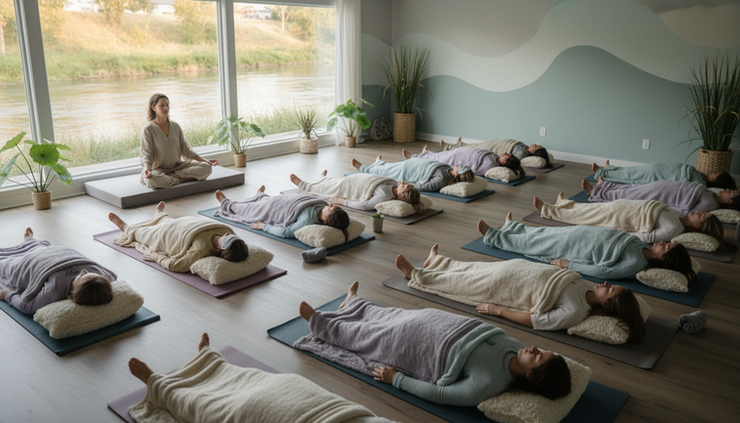
Your first opportunity may come through a relationship
Job postings have their place. Read them. Apply when the fit is real. Prepare your materials and be professional.
But do not make job boards your only strategy.
Your first opportunity may come from the nonprofit director you had coffee with, the veteran group you volunteered with, the school counselor looking for stress-support resources, the gym manager who needs a substitute, the friend who gathers a small private group, or the retreat host who wants a grounded teacher for one morning practice.
That is why relationships matter more than perfect timing.
Build trust. Be clear about what you offer. Show up consistently. Teach within your scope. Keep learning. Let experience shape confidence instead of waiting for confidence to appear first.
If you are ready to train in a way that prepares you for real teaching, mentorship, feedback, and a path beyond the certificate, visit Lotus River Wellness to learn more about LRW programs and opportunities.
Your first yoga teaching job may never appear as a neat listing that says, “New teacher wanted.” It may begin as the right conversation, with the right community, at the right time.
Your Time. Your Journey. Your Impact.


Comments